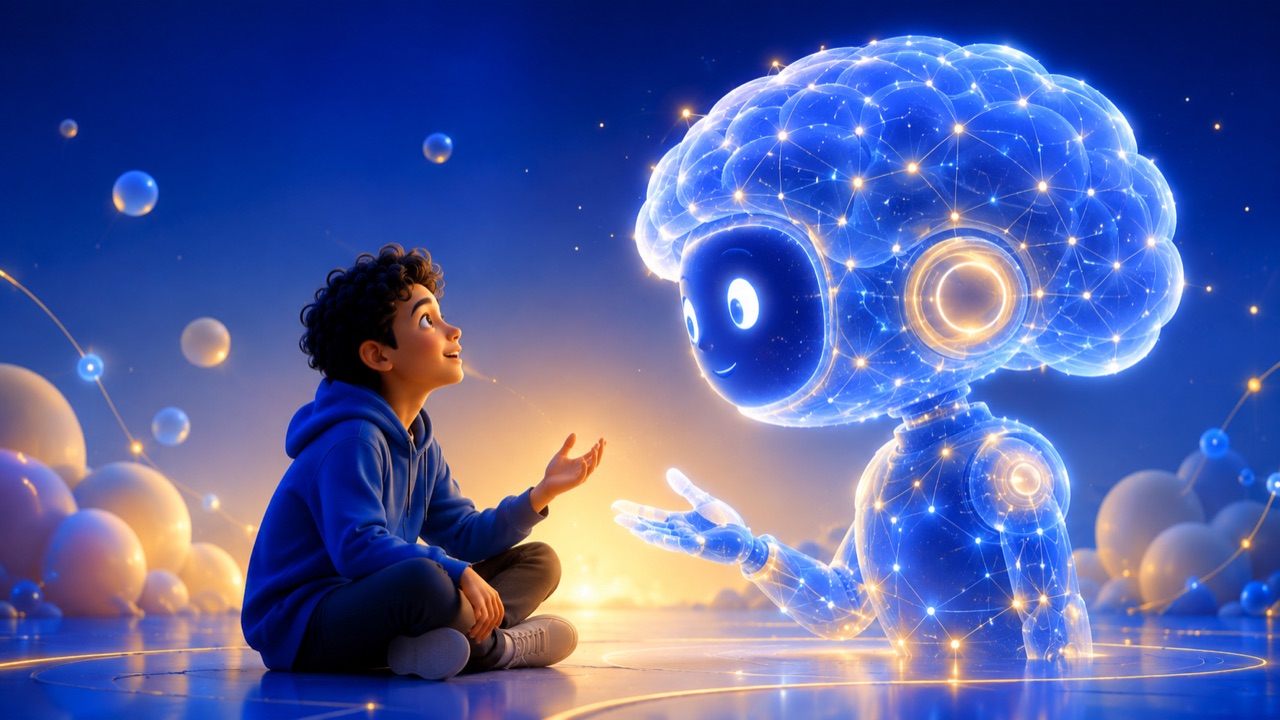
What is artificial intelligence in simple words
Artificial intelligence is the ability of a computer to perform tasks that previously only humans could do: understand language, recognize objects in photos, draw conclusions. The word “intelligence” here does not mean consciousness or feelings. AI doesn't think like you; it finds patterns in huge amounts of data and, based on them, predicts an appropriate answer. Simply put, it is a very powerful pattern finding tool. When you hear “neural network” or “language model”, these are types of AI trained on texts, pictures or sounds.
How AI works
Most modern AI is based on machine learning. Instead of strict if-then rules, the model shows millions of examples, and it itself infers the connections between them. If you want AI to distinguish a cat from a dog, show it thousands of marked photographs, and it will remember the characteristic features. Language models learn the same way, only from texts: they predict the next word over and over again until they learn to put together meaningful answers. After training, the model applies the accumulated experience to new data. The more high-quality examples, the more accurate the result.
Examples of AI in everyday life
AI has long gone beyond the laboratory. A voice assistant in your phone, auto-suggestions when typing messages, recommendation feeds in social networks and streaming, a spam filter in mail, a navigator that guides you around traffic jams - all this works on AI. Banks use it to notice suspicious transactions, stores to offer goods, translators to capture the meaning of a phrase, not just the words. When you ask a chat model to compose a letter or explain a complex topic, you are also using artificial intelligence. Most likely, you touch it dozens of times a day.
Types of artificial intelligence
AI is usually divided into several levels. Narrow (or weak) AI solves one specific problem: recognizes faces, translates text, plays chess. It is he who surrounds us today - with all his power, he cannot do anything other than what he was taught. General AI, capable of thinking broadly like a human, currently exists only in theory and fiction. Even higher is a hypothetical superintelligence, superior to people in everything. It’s important to understand: the real AI tools you work with are narrow AI, and you shouldn’t be afraid of the “rebellion of the machines” here.
Will AI replace my job?
The honest answer is that AI is changing jobs, not just eliminating them. He takes care of the routine—drafting letters, sorting data, doing basic calculations—and frees up time for things that require judgment and experience. More often than not, the winner is not the one who is replaced by the machine, but the one who learns to set tasks for it and check the results. Demand is shifting to people who can work together with AI: faster, more accurately, cheaper. Therefore, the basic skill of handling AI today is as useful as the ability to work with spreadsheets or mail once was. This is not a guarantee, but it is a serious advantage.
How to start using AI today
Understanding theory is helpful, but real confidence comes from practice. Start with something simple: ask the AI assistant to explain an unfamiliar topic, rewrite the text shorter, draw up a business plan, or find an error in the calculations. Formulate the problem specifically and check the answer - this is half the skill. Next, you should study systematically, on real tasks, and not from scattered videos. In LearnAI, you master a skill in practice: you complete tasks with automatic checking, and the AI mentor tells you where you went wrong. The first 14 days are free, so you can try it risk-free.